Axle & Differential FAQ
Frequently Asked Questions
Not sure which axle, housing, or differential fits your truck? These answers cover the questions we hear most. Still stuck? Call us with your axle ID tag info and our team will help you find the right part.
How do I identify which axle or axle housing I need for my truck?
The most accurate way is to identify the axle that’s on the truck now, not just the year, make, and model.
- Find the axle ID tag. Look for a metal tag on the forward side of the axle housing or on the differential carrier. It lists the axle model, assembly/part number, and serial number, which is the fastest way for us to find the correct axle or housing.
- Determine forward vs. rear. On tandem trucks, tell us whether you need the forward-rear or rear-rear drive axle. (This doesn’t apply to single-axle trucks.)
- Check the gear ratio. If you need a differential too, the carrier ID tag lists the model and ratio. On tandem drives, the ratios must match.
- Identify the suspension and mounting. Housings can differ by suspension type and bracket locations even when the differential is the same model.
- Check the axle capacity.
- Use the VIN as a backup. The VIN shows the truck’s original axle configuration, but it can’t tell you whether the axle was replaced later.
Can’t find a tag? Send us photos of the differential, the housing, and all suspension brackets and components, and our team will help identify it.
What is the difference between an axle housing and a complete axle assembly?
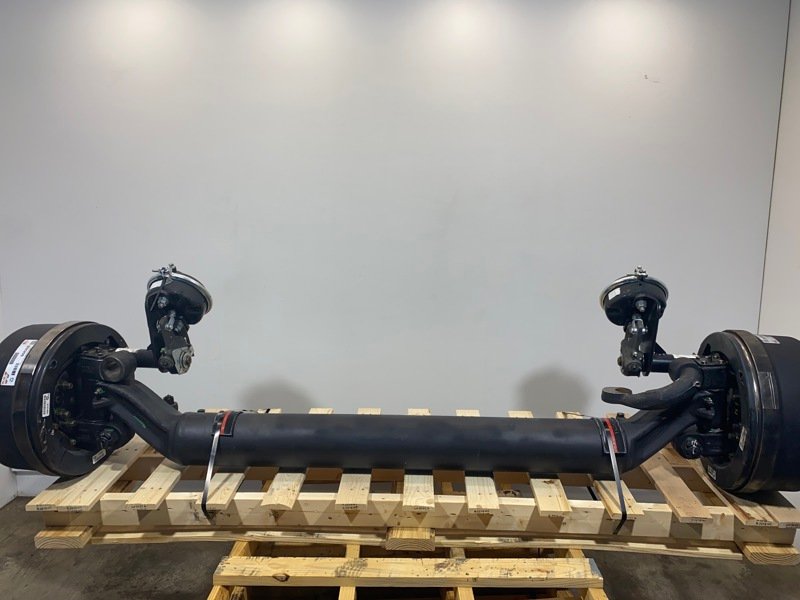
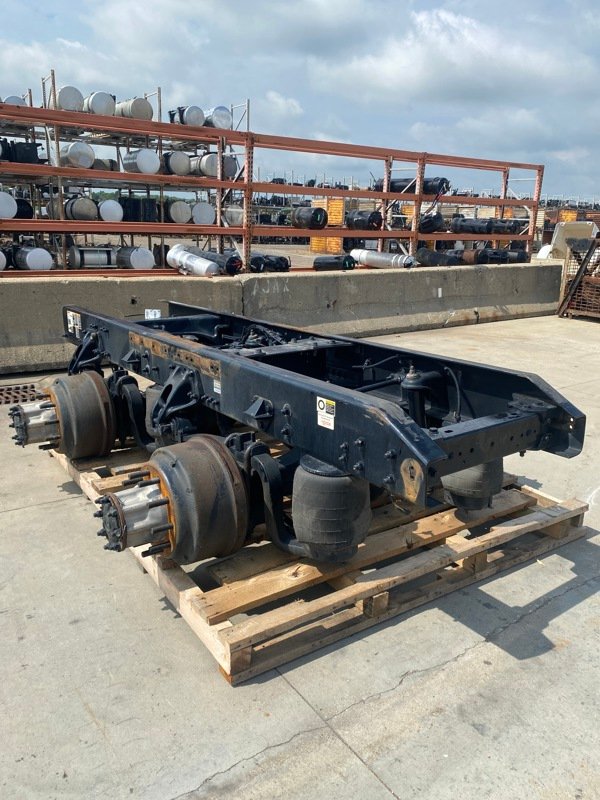
An axle housing is the structural shell that runs from wheel end to wheel end. It’s the cast or fabricated piece the differential, axle shafts, hubs, and brakes mount to. A housing may include the tubes, center section, suspension brackets, and spindle ends, but it usually does not include the differential/carrier, axle shafts, hubs, brakes, or other wheel-end components.
A complete axle assembly typically includes the housing, differential/carrier, axle shafts, and hubs/wheel ends, and may also include brakes, drums or rotors, chambers, and other components.
How do I know what gear ratio my truck has?
- Check the driver’s side door jamb. On most trucks, the VIN identification tag lists the rear axle ratio.
- Check the differential ID tag. The metal tag on the carrier either lists the ratio directly or gives a model/serial number we can use to look it up.
- Count the gear teeth. If the differential is out, divide the number of ring gear teeth by the number of pinion gear teeth.
- Calculate it by hand. Rotating the wheels and counting driveshaft turns gives you an estimate.
On tandem axles, the forward and rear drive axles need matching ratios. If you’re replacing a carrier or complete assembly, verify what’s actually installed rather than relying on the VIN alone.
Can I replace my axle with a different gear ratio?
It depends on the truck and which axle you’re replacing.
- Single drive axle: You can generally switch to a different ratio as long as the replacement axle is otherwise compatible. Expect changes to RPM, acceleration, pulling power, fuel economy, and possibly speedometer or vehicle programming.
- Tandem drive: You generally cannot change the ratio on one drive axle and leave the other as-is. A mismatch causes drivetrain wind-up, tire scrub, excess heat, and can seriously damage the differential or driveline.
Gear ratio alone doesn’t determine fit. You’ll also need to verify the axle model, capacity, suspension/bracket configuration, track width, wheel ends, brakes, carrier, and driveline connections, and factor in your transmission’s output ratios.
How do you cross-reference an axle part or model number?
Start with the axle ID tag rather than the VIN. The tag lists the model number, serial number, assembly/part number, ratio, and build date. The characters in the model number describe the axle family, capacity, gearing, and application.
That number can be looked up in the manufacturer’s parts catalog to confirm specs and find compatible assemblies. You’ll want to verify the axle family/model, capacity, housing configuration, suspension, track width, spindle/wheel-end setup, carrier mounting, and brake configuration.
The easy way: give us a call with the numbers from your ID tag and your Frontier sales rep will cross-reference it for you.
What are the signs of a failing differential?
A failing differential usually gives warning signs before it fails completely. Watch for:
- Whining or howling that changes with speed, often a worn ring-and-pinion or incorrect gear setup.
- Grinding, clunking, or banging from gear wear, damaged teeth, worn bearings, or excessive backlash.
- Vibration through the driveline (rule out driveshafts, U-joints, and tires too).
- A clunk when switching between acceleration and deceleration.
- Gear oil leaks at the pinion seal, axle seals, or carrier.
- Metal in the gear oil. Fine material suggests wear; flakes or chips point to internal damage.
- Overheating from low or wrong lubricant, bearing problems, poor gear setup, or overloading.
- Binding or loss of drive in severe cases.
When the noise happens (under acceleration, while coasting, or all the time) helps pinpoint the cause. If you have loud grinding, banging, binding, a major leak, or metal chunks in the oil, have the truck inspected before driving further. Continuing can turn a repairable problem into a full axle failure.
How do I know a reconditioned axle housing from Frontier will be good?
Every reconditioned axle housing goes through hot tank cleaning, abrasive media blasting, specification verification, and professional repainting. At each stage, our technicians inspect for cracks, corrosion, and pitting, and check bearing surfaces for excessive wear.
Only housings that meet our standards are offered for sale, and every reconditioned axle housing is backed by a 180-day parts warranty.
Shop Axle & Wheel End Parts
Find The Right Axle for Your Truck
Replacing an axle on a heavy-duty truck comes down to getting the details right: the axle model, capacity, gear ratio, suspension mounting, and whether it sits in the forward-rear or rear-rear position. Frontier Truck Parts carries axle housings, differentials, and complete axle assemblies for a wide range of makes and models, and our team helps you match the right one to your truck.
Have your axle ID tag handy and we can usually identify what you need fast. No tag? Send us photos of the housing, differential, and suspension brackets and we’ll take it from there.
Frontier is a proud member of the Weller Auto Parts family of companies, with over 90 years of experience supplying dependable used medium- and heavy-duty truck parts.